

Everyone's a Middle Manager Now
The data is in on what AI is actually doing to knowledge work

Welcome to The Third Hemisphere, where I try to make sense of how AI is reshaping work, thinking, and creativity, often by watching my own assumptions get upended.
If you were forwarded this and want to subscribe, click below. If you want to support a real human writing about AI, upgrade to paid.

I recently began managing people. This was not, exactly, by choice, but I do appreciate its benefits. I’m excited about the projects I can do with more people-power, and I genuinely like the people I’m managing. But I’ve spent my career avoiding management because I dislike what it does to my mind. Instead of deep work, I must maintain a low-level awareness of the statuses of multiple people and their workflows on multiple projects. I have to field incoming queries at unpredictable times. Although I tried putting barriers around my management time, I’ve since resigned myself to being available because failing to respond can send a project off the rails, costing me many more hours of cleanup than the interruption would have. So now, my focused work is increasingly relegated to the interregnums between pings. “Dude, this is just how work works,” I can hear some of you saying. Fine. But it wasn’t how work worked for me until recently, and it has changed the nature of my job. I am less of a doer now than a manager of doers. My mind used to be focused most of the day and scattered some of the day; now it’s the reverse.
Last fall, I wrote a piece about the substitution myth, the deeply held and deeply wrong belief that you can swap a machine in for human labor and expect the nature of the job to stay the same. The argument is that automation doesn’t subtract tasks from a job. It shifts the equilibrium of the entire system, transforming the human’s role in ways nobody planned for. Self-checkout was supposed to eliminate cashiers; instead it turned them into tech support specialists managing multiple malfunctioning kiosks. Electronic health records were supposed to reduce paperwork; instead doctors spend their evenings clicking through charts in what the profession euphemistically calls “pajama time.” The substitution myth predicts that AI would follow the same pattern: as certain tasks get automated, and the nature of the job fundamentally shifts.
Well, the data is in, and to my great dismay, a shift in the nature of knowledge work is underway, and it’s towards…more management. But not of people, of AI.
A new report from ActivTrak tracked behavioral workforce data across more than 1,100 companies and 160,000 employees. On the surface, the numbers paint a picture AI enthusiasts would be excited about. AI adoption has hit 80% in employees, productive hours are up 5%, and workdays are slightly shorter. One takeaway: More people than ever are using AI to get more done faster.
But let’s look at the texture of this transformation. A subset of about 10,500 users had their work tracked 180 days before and after they adopted AI tools. Time spent across every measured work category increased. Email up 104%. Chat and messaging up 145%. Collaboration time surged 34%, to nearly an hour a day. Multitasking rose 12%, to an hour and a half. Where is this time coming from? In 2023, the average knowledge worker’s focused session lasted about 14 and a half minutes. By 2025, it was down to 13 minutes. That doesn’t sound like much until you realize it’s a 9% decline in just two years, and that the trend has been consistent and downward the entire time. Focus efficiency, the share of work time spent in uninterrupted, single-task activity, dropped to 60%, a three-year low.
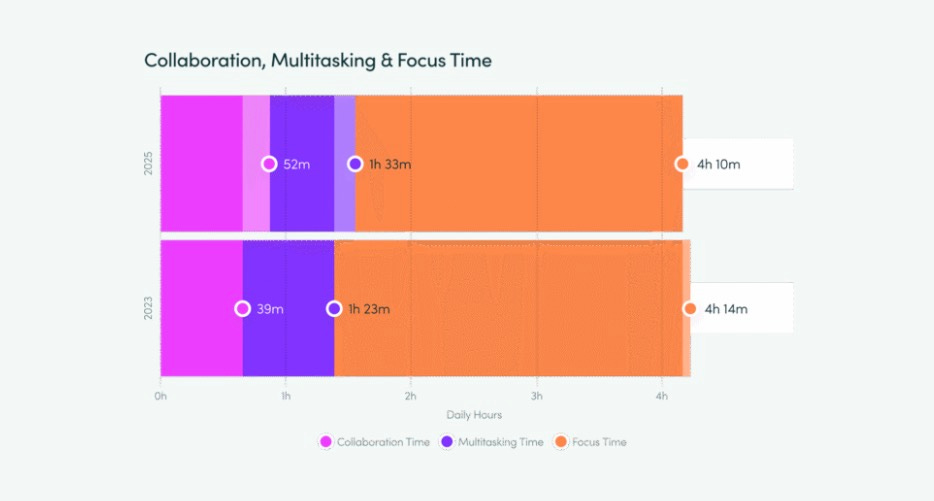
People are getting more done, but look at what “more” means: more emailing, more messaging, more coordinating, more switching between tools. This is essentially a portrait of management, the pinging and checking and status-tracking that keep workflows moving. The activity that is in freefall is the one that looks like actual work: focused, uninterrupted time spent doing one thing.
To understand what this shift is doing to people, consider this other very recent study from Boston Consulting Group. The researchers surveyed nearly 1,500 full-time U.S. workers and found that 14% of those using AI reported what they somewhat clickbait-ily call “AI brain fry,” defined as mental fatigue from excessive oversight of AI tools. Workers with high oversight demands expended 14% more mental effort, reported 12% more mental fatigue, and experienced 19% greater information overload than workers with low AI oversight. People described a “buzzing” feeling, mental fog, difficulty focusing. One senior engineering manager said: “I was working harder to manage the tools than to actually solve the problem.” Francesco Bonacci, an engineer and AI startup founder, wrote a post called “Vibe Coding Paralysis” in which he described his days this way: “I end each day exhausted—not from the work itself, but from the managing of the work.”
History may not repeat itself, as the saying goes, but it does rhyme. In 1983, studying a different technological shift, Lisanne Bainbridge published a short, devastating paper called Ironies of Automation. She had been studying control room operators in power plants and factories, and she noticed that the more reliably automation handled routine tasks, the worse operators performed when they needed to intervene. Factory workers who used to machine things became people who monitored machines machining things. The easy parts of their job had been automated, which made the hard parts harder.
But Bainbridge’s operators faced a specific cognitive problem: vigilance. Their job was to sit and watch dials. Humans are terrible at sustained vigilance; our attention degrades within minutes when nothing is happening. Bainbridge’s cruel irony was that when something did go wrong, like, for example, when the alarms started screaming at Three Mile Island, the operators couldn’t comprehend the gravity of the situation because they’d been passive monitors for months. In plants and factories, the cognitive cost of automation was slow, undetectable skill atrophy punctuated by catastrophic confusion during rare emergencies.
The shift from knowledge worker to manager of AI will certainly result in skill atrophy of the underlying tasks, just as Bainbridge would have predicted. But AI also adds another issue her operators rarely had: cognitive overload. According to ActivTrak, the average organization now runs seven AI tools that workers might be expected to use. That means a worker might be actively evaluating, constantly deciding, checking outputs, re-prompting, comparing versions—all this while switching between seven AI tools. AI generates so much output, so quickly, that the oversight itself becomes overwhelming, which fragments attention, which then degrades the quality of that oversight. There are skills that can help—one might even call it “management training”—but companies don’t seem to be reskilling people in management. They are just throwing AI tools at them and literally asking them to just manage, as if they are doing the same job but with an updated piece of software.
I think it’s important to state that this shift will be just fine for some people. Most, perhaps. “Brain fry,” or whatever you want to call it, won’t happen to everyone (in fact, it was only observed in 14% of participants in the BCG study). Some people are natural-born managers. They’ll thrive overseeing AI. Just as some factory operators were probably happy to sit back and monitor systems in an AC’d control room rather than wrestle with an oily machine on the floor for 8 hours a day, some white collar workers will be happy to type formulas into an excel sheet again, even if it means more split attention and task-switching.
But the people who chose their work because they loved the craft of it, the coder who loved elegant solutions, the writer who loved crafting the perfect sentence, the designer who loved diving deep to find just the right color combination, those people are being told, or are just finding out, that their new job is management. The substitution myth promised that automation would free them up for deeper, more creative versions of the work they already loved. Instead it is replacing that work with something cognitively different, and for many people, like me, something much less interesting and fulfilling.
I have a very cynical, but perhaps not inaccurate, hypothesis about what 'automation' in all its forms is actual doing. The hypothesis is that essentially all the important work in organizations is done by front-line staff trying to solve customers' problems by working around the impediments put in place by management (especially in the form of new, employee-hostile and customer-hostile technologies).
If I'm correct, we could, as quickly as possible, simply eliminate middle and senior 'management', empower the people who actually know what customers want and need to provide what they want and need, and, by eliminating the exorbitant senior management salaries, pay these actually useful employees a decent wage and still be able to sell the company's products and services for less. It would of course require some time for those staff to learn to use their new authority and capabilities effectively, but I am confident it would pay off in multiple positive ways.
Why will this never happen? Because management doesn't actually exist to make important decisions or solve real problems. Look at most management 'activity' these days and it's pretty much entirely setting 'objectives', sending out accompanying spreadsheets, and leaving it to the front line staff to figure out how to achieve the 'objectives', which are likely nonsensical (since management is completely buffered from contact with customers) and still meet customers' needs.
Why haven't managers all been fired then? Because 'management' is actually a tax shelter to allow the company's owners to redistribute profits and wealth to family and friends so they don't have to pay tax on it. It's merely another poor-to-rich income and wealth redistribution scheme. With today's technology and information, management isn't actually needed at all if staff were simply empowered to do their jobs.
That's my main lesson from a lifetime in business, most of it in 'management' positions.
Bainbridge 1983 — идеальная рамка. Ирония автоматизации: чем надёжнее система, тем менее компетентен оператор в момент сбоя. С ИИ добавляется второй виток — не атрофия навыка, а когнитивная перегрузка от надзора. Самое точное в статье: замена не задачи, а природы работы. Те, кто выбирал профессию ради ремесла, обнаруживают, что ремесло теперь — менеджмент. — @lintara