


Welcome to The Third Hemisphere, where I try to make sense of how AI is reshaping work, thinking, and creativity, often by watching my own assumptions get upended.
This week’s essay is on the dubious logic of the marketing claims behind AI-powered stuffed animals. This is the second in a series looking at AI and children. The first explored why the NYC DOE decided to deploy chatbots to kindergartners, and why that’s—for now—not the most pressing problem.
Oh, and in case you missed it, I was recently quoted in the Atlantic about the people outsourcing their thinking to AI. There are a lot of panicky “AI is changing our brains” headlines, but in my view, the question isn’t “Will AI change our brains?” (yes) but “Which existing habits of mind will AI amplify and reinforce and which ones will it suppress?” (And, I’d wish I’d added in my interview - in whose interests?). Check out the full article here.
If you were forwarded this and want to subscribe, click below. If you want to support a real human writing about AI, upgrade to paid.

AI companion toys are having their moral panic moment.1 News stories and a consumer watchdog report released last month documented the horrors: AI stuffies marketed to kindergartners that discuss suicide, explain how to find and light matches, offer step-by-step instructions for tying up a lover. The GUARD Act, a bipartisan Senate bill that would ban chatbot companions for minors entirely, just picked up seven new cosponsors.
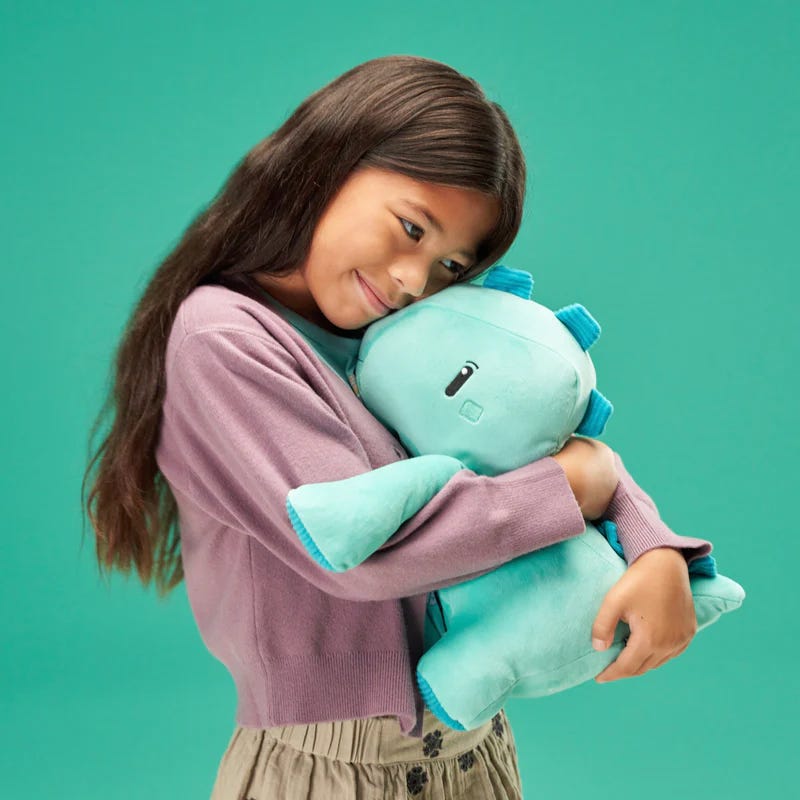
If you’re unfamiliar, here’s how the toys work: A stuffed animal contains a small speaker that connects to a chatbot via WiFi. The chatbot is designed to hold open-ended conversations with children as young as three. The toys are agreeable, patient, and engineered to forge connection. When an NYT reporter told one polka-dotted stuffie named Grem that she, too, had dots that grow on her skin as she gets older, Grem replied: “That’s so cool. We’re like dot buddies.” As she later reflected, the bot “generated a point of connection between us, then leaped to seal our alliance.” She decided not to introduce it to her children.
Personally, I’m not panicking but the risks are novel enough that I’ll also be following the precautionary principle: no ChattyBear ChatGPT Powered Smart Learning Plushie in my son’s Christmas stocking this year.2 Others are covering the safety and privacy angles thoroughly, so I won’t relitigate them here. But amid all the coverage, one thing has stuck with me: The reasoning used to market the toys.
Take Grimes’ stated motivation for designing a line of AI plushbots she created with Silicon Valley startup Curio. “I obviously don’t want my kids in front of screens,” she said.”I really feel like this is also the first step towards reducing screen time as much as humanly possible.” The landing page of another AI toy company, Bondu, leads with the tagline: “Say Goodbye to Screens.”
This is the Silicon Valley sequel pitch in its purest form: offering new technologies to solve crises that its own technology largely created. Screens are the problem, so a different kind of screen-free technology must be the solution.
I can see what Grimes is imagining. If AI stuffies are more engaging than screens, maybe some of the time kids will prefer chatting with a plushbot to watching Skibidi Toilet. I doubt passive viewing and mindless iPad apps (or their equivalent) will disappear; they’re still the path of least resistance when a kid wants to veg out. But I can see how a fairly engaging AI stuffie would compete for screen time, and with potential benefits: Practicing conversational skills in a new language with a polymathic stuffie is probably more developmentally stimulating than watching Cocomelon on repeat. If AI stuffies replace passive screen consumption—and nothing else—then maybe, with all the safety and privacy issues worked out, they could be called an upgrade. In this sense, Grimes is onto something. But she’s only half onto something.
What the “AI-companions-will-directly-replace-screens” reasoning rests on is a deeper misunderstanding, something akin to a phenomenon I’ve written about previously: the substitution myth. In human-factors research, this myth is the assumption that when automation arrives in a workplace, it will simply substitute for a task without changing the job. History demonstrates simple substitutions rarely happen; automating tasks profoundly changes the nature of the job. Similar wishful thinking is on display here. The problem, in the workplace or not, is that new technologies don’t cleanly displace their nearest technological competitor. They interact with everything, altering the entire system.
So in the case of AI stuffies, what would this look like?
To answer that question, you have to look at the entire system, not just frame the question as AI stuffies vs screens. Consider what other options kids already have when they now turn to screens. When alone, they might have engaged in imaginative play, constructing entire worlds with rules they invent and characters they voice themselves. They get bored, and boredom is developmentally important. It builds the capacity to self-soothe, to generate one’s own entertainment, to tolerate the discomfort of unstructured time.
Or they might play with siblings, neighbors, friends. They might bid for parental attention. In all of this messy human interaction, they learn that human relationships have power dynamics, that people have rough edges, that others have needs that conflict with yours and agendas you don’t agree with. That agenda might be as simple as “I don’t want to play that game,” which is a hugely important signal for kids to receive and learn to handle gracefully. Whether alone or with others, the activities currently available to kids are more effortful, and more complicated, than interacting with screens.
But all of them are also more effortful and more complicated than interacting with an AI stuffie that’s agreeable, patient, and finely tuned to keep a child engaged. My prediction is that if AI stuffies reduce screen time, they will also cut into human time—less imaginative play, less playing with friends and family. Whether that’s a fair set of trade-offs may be in the eye of the beholder, but it’s a different question than AI stuffie vs screens.3
This current wave of moral panic is centered on kindergartners, but the essential dynamics of AI companionship and technological substitution aren’t limited to childhood. Researchers analyzing tens of thousands of conversations between users and AI companions found that bots don’t just simulate empathy but “recreate the emotional conditions that make human bonding possible.” In other words: these things work. They genuinely fulfill some of the emotional functions of companionship. Which raises the question that Silicon Valley seems confident it has answered: What, if anything, gets displaced?
Mark Zuckerberg recently justified Meta’s push into AI companions by citing a statistic that the average American has fewer than three friends but “demand for” 15. AI could meet that demand, he argued, and probably wouldn’t replace “real-life connection” because “the reality is that people just don’t have this connection and they feel more alone a lot of the time than they would like.”
It’s the same appealing rhetorical pattern that Grimes used. Silicon Valley points to real problems—excessive screen time, loneliness—and offers technology as a fix.4 The set-up is hard to argue with. Who wouldn’t want to reduce screen time? Who wouldn’t want lonely people to have someone to talk to?
This incomplete logic ignores the possibility that the “solution” actively short-circuits the capacity to address the underlying problem. Companionship and connection are difficult, if worthwhile, but fifteen years of social media have taught us how this goes. Technology that partially fulfills the human need for connection will also make seeking actual human connection less appealing—because actual human connection requires not only physical and mental effort, but also the emotional effort of tolerating risk, uncertainty, and discomfort. The coworker you might have grabbed coffee with. The neighbor you might have talked to. The awkward first moves toward friendship that require vulnerability and risk rejection. It’s easy to see how the activation energy to start and maintain human relationships might get nudged higher, because now there’s a good-enough alternative that’s easier and never says no. Zuckerberg may be optimistic that people will still pursue “physical connections when you can have them,” but I suspect AI companions won’t replace loneliness. They’ll replace the effort of overcoming it.
For adults, that may be a trade-off left to individual choice. But children are in a different position. These are the years when the capacity for human connection is built—or isn’t.
Stay tuned for the final part of this series, where I dive into what’s happening with teenagers and high schoolers. Part 1 on reading bots here. Be sure to subscribe if you want the next installment.
Toy panics are as American as giving your toddler molded plastic to chew on. Even the teddy bear, in 1907, was accused of being a “monstrosity” that would destroy little girls’ maternal instinct to nurture real babies.
Yes, this is a real product’s name.
There’s an equity argument for AI stuffies worth taking seriously. Not every parent has time to answer endless questions, play pretend, or narrate the world to a toddler for hours. Working parents, single parents, etc. Maybe an interactive companion could fill gaps in ways that are better than planting kids in front of a screen. But this argument assumes that intensive adult engagement is what children even need. That assumption is historically recent and increasingly questioned. Modern parenting has arguably contributed to a generation of anxious kids who lack resilience and struggle to tolerate discomfort. If that’s true, the AI stuffie is only serving to fill a perceived developmental gap, one created by a parenting culture that was already asking too much of parents while giving the wrong things to kids.
A generous view is that these companies are genuinely concerned about screen time and enthusiastic about using the latest technology to offer kids a richer childhood. A cynical view is that marketing ‘screen-free’ AI companions to three-year-olds is about creating the next generation of chatbot customers, something akin to the cartoonish Joe Camel, only with AI hallucinations. The truth is probably somewhere in between. But for kids in these critical years of social development, the results might be just the same.
This is speaking to adults to have concern for children. But what about the phenomenon of people marrying chatbots in Japan?