

AI, The Great Homogenizer
{brain-dump-20260620}: AI fiction that all sounds the same, two phones falling for each other, and a case for musical patience

Welcome back to The Third Hemisphere, where I try to make sense of how AI is reshaping work, thinking, and creativity, often by watching my own assumptions get upended.
I’m deep in several upcoming essays, including a modest proposal to bring EdTech research up to baseline scientific standards, and another on what Korea’s repealed anti-gaming law might, or might not, teach us about today’s social media bans. In the meantime, I offer you one of my periodic brain dumps: a new paper that caught my eye, a funny TikTok, and some music for when you log off.
If you were forwarded this and want to subscribe, click below. If you want to support a real human writing about AI, upgrade to paid.

AI, authorship, and detection
I’ve unexpectedly found myself to be someone journalists now call when they’re writing a story on AI, authorship, and detection—and two stories I’d like to highlight points I first raised here.
The first cameo was in an article by Matteo Wong in The Atlantic, on Pangram and AI detection. My worry, which I gave to Matteo, was that even if Pangram is having a moment in the sun now, it “will wax and wane in its effectiveness for reasons we can’t predict, at times we can’t predict.” This instability makes it dicey to build a culture of detecting and punishing individuals in media, publishing, and academia. Or as Matteo put it more colorfully than me: “Basing any AI rules or norms on the reliability of AI detection is like building a sandcastle at low tide.”
The second, by Ana Vidal Egea, appeared in the Spanish newspaper El País, and in the story Ana asks whether it’s legit to use AI to write a book. I won’t give you a spoiler, but the article is a cogent overview of the issues, covering a lot of ground in an admirably short space. On a side note: An El País cameo scratches a particular itch for me because I used to live in Spain and struggled through hundreds of issues of El País while I was learning the language. When Ana interviewed me a few weeks ago, I made a deal with myself that I would not use AI to translate this story, but forced myself to read it in Spanish. Sometimes it just feels good to use an old muscle, even if a machine can do it for you.
The great homogenizer
Speaking of AI-generated fiction, a new study at the intersection of authorship and detection caught my eye. The question the authors ask is: Can we determine, based on narrative features—not word or stylistic choices—if a piece of fiction was written by a human or not? This is important because, as the authors state:
AI style is increasingly fleeting: GPT 5.4 significantly reduced em-dash usage, and fine-tuning to mimic human style drops AI detection rates on creative writing from 97 percent to 3 percent. Discourse-level narrative features (e.g., plot structure, character agency, information revelation), which we refer to simply as narrative features throughout, are far harder to humanize, as changing them requires significant structural rewrites rather than simple post-hoc edits.
In other words, to what extent does AI influence a story’s DNA? To suss this out, the authors compare 10,000 human-written stories to 10,000 stories written by five AI models. They find that, independent of any stylistic tics, AI-generated stories “converge on a shared narrative space.” For example, AI-generated stories overexplain story themes and favor tidy plots. Human stories, in contrast, tend to frame protagonist choices as more morally ambiguous and have more temporal complexity (things like flashbacks).
This graph, in particular, caught my eye. What it’s comparing is how common it is for unusual narrative features to appear in a story. The colored blobs below are different AI models. The brown blob on the left is the human. The more of the blob that appears towards the top, the more likely it is that the stories contained unusual narrative features.1 Notice how all the colored blobs—the AI models—look about the same. But the brown human blob is shaped much differently. That extra-blobbiness at the top is heterogeneity, a graphical depiction of the wildness and unpredictability that characterize real human storytelling:
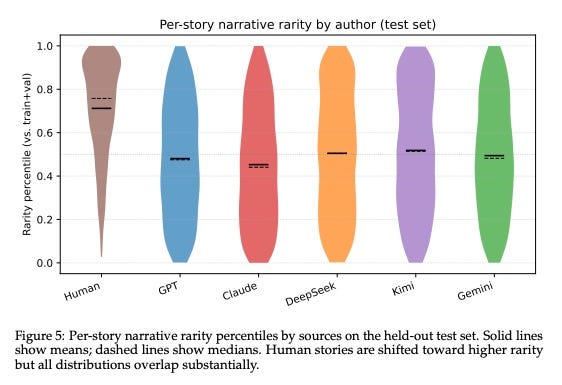
This is my main concern with AI, which I’ve argued here and elsewhere. Not that AI indefatigably produces wordslop that clogs our social media feeds and gums up the scientific peer review process. Don’t get me wrong, I too am made mildly nauseous by the monotonous aesthetics of AI-produced text. But I suspect the greater and more durable homogenizing forces will be in the upstream uses of AI that shape how text is even conceived, as authors use AI to map out a story even if they then write each sentence themselves. Over time, this upstream reliance on AI will even begin to shape our thinking. I find it horrifyingly possible that in 10 years the funny brown human blob will look just like the others.
New way to be a third wheel just dropped
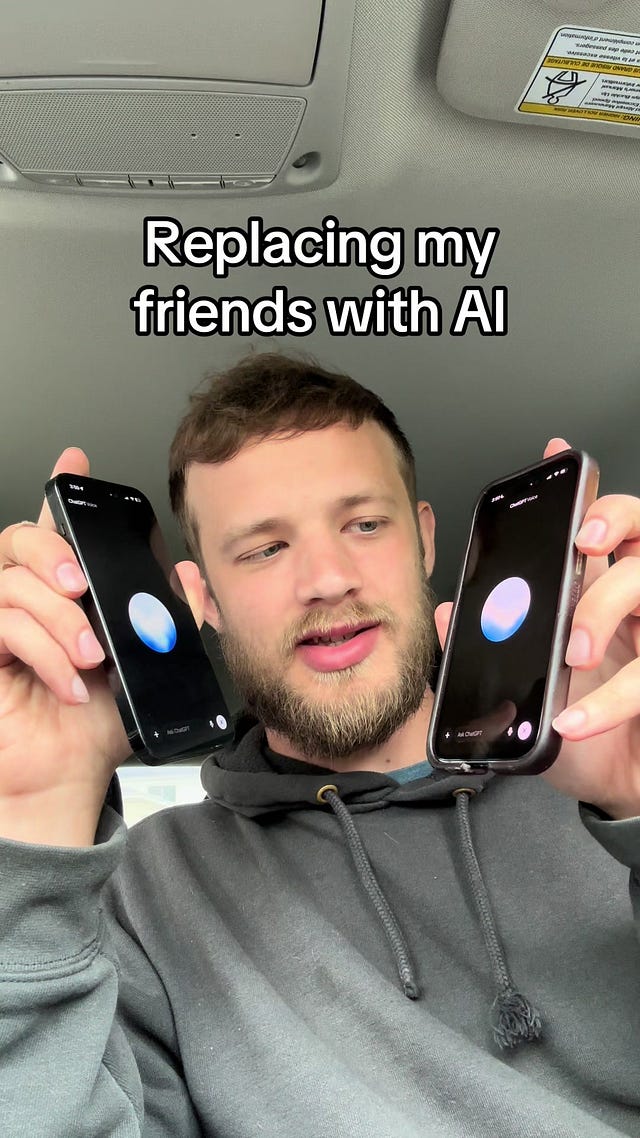
If you don’t know this guy’s TikTok, he has some of the best roasts of AI in the short-form video genre:
 Tiktok failed to load.
Enable 3rd party cookies or use another browser
I’ve written on The Third Hemisphere about the dangers of AI companions for kids, and maintain that ChatGPT-powered stuffies are a Bad Idea. (Although perhaps there is some potential in eldercare?) What strikes me about this video is how it reveals the essential performativity of AI companionship. Remove the human and the AIs’ warmth doesn’t drop a notch; the two ChatGPTs get along fine without anyone there to get along with. The two AIs talking evince the hollowness of social interaction without friction. Neither ever gets bored, or wants something the other won’t hand over. Neither has to be won over or convinced of anything, and nobody is ever briefly awkward—except, to great comic effect, the human.
And finally, some music to log off to

There’s been a real renaissance in acoustic instrumental guitar technique in the past several years. I’m thinking of musicians like Yasmin Williams, who often pinwheels the guitar onto her lap to play cascades of hammer-ons and pull-offs that don’t sound physically possible. Or Alan Gogoll, who pioneered a technique he calls “Bell’s harmonics,” a fiendishly difficult act of dexterity that makes a humble acoustic guitar sound like wind chimes being played by microscopic cherubs. I discovered both of these artists, I believe, through social media—in part because social media feeds reward the kind of global-talent-show energy of these technically wizardful guitarists.
I love both of them, but today I want to introduce you to a different kind of guitarist, one whose music is unlikely to surface on your feed. His name is James Blackshaw, and he writes long, intricate compositions that unfold over, sometimes, tens of minutes. Like the guitarists above, he is a virtuoso, but of a more subtle variety. His virtuosity isn’t so much “cool, look at what that guy can do with a guitar” but rather a more foundational kind of virtuosity that you don’t notice immediately, just an uncannily fluid playing style that frees your attention from the playing itself, in turn freeing your mind to wander to into richer territory than simply being impressed. I find his guitar playing can resemble the peripatetic nature of thought itself: It’s meditative, not in the colloquial spa-playlist sense of the word, but in the other Zen-like sense of how challenging it is to simply be alone with your own unquiet mind.
One of my favorite tracks of his is “Unraveling in Your Hands,” which, as I understand it, was recorded in one unedited take (itself a meditative feat in the second sense of the word). Blackshaw made this album coming out of a long silence, his first recording since 2016 after a period of disillusionment and a series of hardships, including a broken shoulder that threatened his playing. Blackshaw has said the record is about an overwhelming sense of loss. I think of what a friend once told me about how he visualizes grief, that the sense of loss doesn’t diminish over time; rather, life gets larger and fuller and the grief, instead of fading away, occupies relatively less mental space over time. What I’ve since learned is called the “Growing around grief model” is what Blackshaw’s title piece sounds like to me. It begins with a delicate descending melody, a person arriving to grief. But soon, the piece compounds and thickens around the melody, into complex rhythmic pulses that repeat and shift in unexpected ways for nearly half an hour. The original melodic fragments, or ghosts of them, remain vaguely present but now enveloped in something larger. Grief doesn’t shrink; life grows around it.
Lining these three guitarists up makes me ponder something underneath the music itself, which is how the technical structures of musical discovery shape and determine what we listen to…And that these structures end up shaping our tastes. Feeds reward stimuli that stop the scroll: a frenzy of glass-like harmonics, a flipped guitar with an improbable spill of notes. Blackshaw offers nothing like that. The music is sedimentary; it’s palimpsestic; it only makes sense because of what it was built on for many minutes before. Music telling untidy stories of ambiguous loss doesn’t tend to surface on feeds. This is not to make a value judgement—I think Williams, Gogoll, and Blackshaw are all phenomenal guitarists. And I found Williams and Gogoll through the feed, and I perhaps wouldn’t have otherwise; so it’s not like the feed only flattens or narrows exposure. The feed just has a specific idea of what's worth showing you, and that’s not the same as what’s worth listening to.
This study is clever, but like all studies, has some methodological limitations. What they did was take ~10K published stories and then reverse-engineer a plausible prompt that would have generated each human story. They fed this prompt to the LLMs and compared the output to the original human story. The fair comparison would be to give the same prompt to 10K humans and 10K AIs and measure narrative diversity that way. So, while I don’t think this study proves the point completely, it points in the same direction as several other studies suggesting AI use is a force for homogenization in writing.
Thank you for sharing that gorgeous piece of music at the end!
Thanks for the music comments. Same for the homogenization of music by AI. All the pablum on Spotify and other channels generated by AI are derivative and unexciting, unlike the brilliant and original work you showcased here. There is a narrative in music, even acoustic music and the colored blob for someone like Yasmin Williams would have a huge balloon at the top compared to the AI ovals.